

Best 10 AI Prompts for Glamorous Fashion Editorial Photography
Fashion editorial photography thrives on impossible beauty, and AI image generation pushes that boundary into pure surrealism. This collection of ten prompts reimagines luxury through medical-surrealist portraits, futuristic automotive design, architectural food art, and celestial interiors, each demanding photorealistic precision and zero text. The shared scene is a gallery of hyper-premium concepts where organic forms fuse with mechanical, edible, or crystalline materials under cinematic lighting.
These prompts are not just about clothes or models—they construct entire worlds inside a chest cavity, a water droplet, or a vinyl-record mountain range. Every image must feel like a high-budget editorial spread, with 8K detail, ray-traced reflections, and a strict ban on logos or typography. The article unpacks what each prompt asks for, why these surreal combinations work, and exactly how to generate them using today's top AI tools.
What this glamorous fashion editorial collection asks for
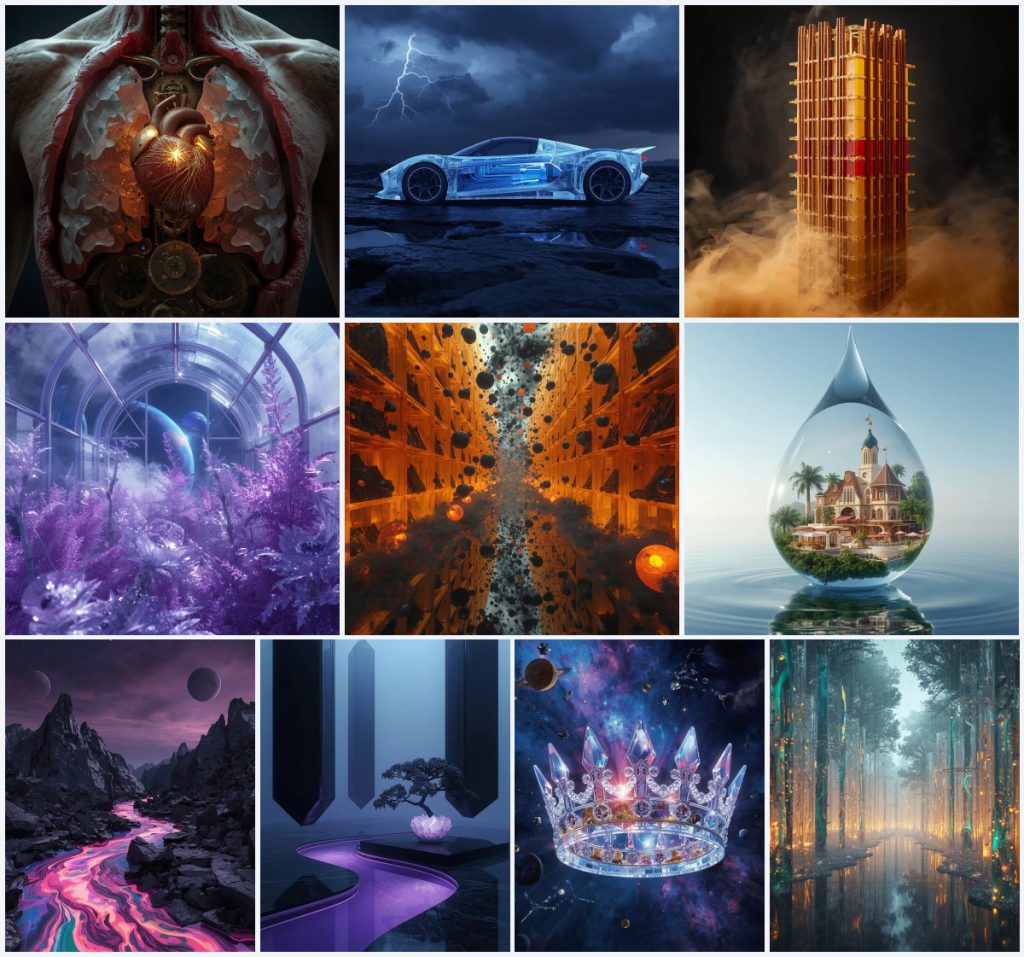
Across all ten prompts, the common demand is a hyper-realistic, text-free composition that treats luxury materials as living architecture. The open chest cavity prompt, for instance, swaps flesh for antique brass clockwork and a star-heart wrapped in golden wire, while the glacial hyper-car reveals a fiber-optic engine through translucent ice. Every image must feel like a premium magazine cover, with extreme macro detail, cinematic lighting, and 8K resolution.
- Antique brass clockwork gears and a miniature glowing star heart wrapped in golden wire
- Translucent glacial ice body with a fiber-optic and liquid mercury engine glowing blue
- Structural beams of roasted cinnamon sticks and saffron-infused gelatin walls with gold-leafed papadum balconies
- Hand-blown glass plants—violet ferns, crystal roses, chrome vines—inside a neon-vapor-filled greenhouse
- Floating memory orbs with trapped lightning bolts inside an amber-shelved infinite library
- A giant water droplet containing a luxury food paradise with dessert gardens and beverage districts
The shared scene across these ten surreal editorials
The collection builds a cohesive universe where luxury materials defy their natural state. In the medical-surrealist portrait, "the skin around the cavity is peeling back to reveal a landscape of deep-space nebulae instead of muscle," turning a body into a cosmos. The automotive render places a hyper-car "on a dark, wet volcanic rock surface that reflects the car's icy silhouette and internal glow," with a "stormy indigo" sky crackling with lightning that "highlights the sharp, frozen edges of the vehicle."
Elsewhere, the edible skyscraper floats in "a haze of aromatic cardamom smoke," while the Zen garden features "massive, transparent, matte-black obsidian prisms levitating at different heights" above a river of "thick, viscous, 'liquid shadow' that emits a soft, chilling violet glow." The landscape shot unifies the aesthetic with "jagged, towering mountains made of black, glossy, melted vinyl records" and a "river of thick, molten, glowing liquid diamond" under "a melancholic, bruised violet sky with three giant, ethereal moons." Every scene insists on a pristine, no-text visual composition.
Why these prompts create powerful fashion editorial images
Fashion editorials sell aspiration through visual shock, and these prompts weaponize material contrast—flesh versus clockwork, ice versus lightning, spice versus skyscraper—to stop the viewer mid-scroll. The hyper-realistic mandate ensures the surreal elements feel tangible enough for a luxury campaign, while the strict no-text rule keeps the focus purely on texture, light, and form. Together, they produce images that look like they belong in Vogue's avant-garde portfolio or a high-concept automotive ad.
- Material contrast—like brass gears inside a chest or vinyl mountains—creates instant visual tension that reads as high fashion
- Cinematic lighting and 8K detail mimic the production value of real editorial shoots, making AI output usable for mood boards
- The zero-text, zero-logo constraint forces pure visual storytelling, exactly what art directors need for clean campaign layouts
Three visual styles embedded in this collection
The prompts weave three distinct visual styles into their DNA, each enhancing the editorial feel without breaking the surreal premise. Medical surrealism dominates the clockwork chest and mechanical lungs, organic-mechanic fusion drives the glacial car and glass greenhouse, and architectural food art defines the spice skyscraper and water-droplet paradise.
- Medical surrealism: This style turns anatomy into machinery, as seen in the open chest cavity where "mechanical lungs made of folded, translucent paper breathe in clouds of stardust."
- Organic-mechanic fusion: This blends living and synthetic forms, like the hyper-car "carved from a single, massive piece of translucent glacial ice" with a "glowing blue engine made of fiber-optic cables."
- Architectural food art: This constructs buildings from edible materials, exemplified by the skyscraper with "translucent sheets of saffron-infused gelatin" walls and "ornate, edible gold-leafed papadums" for balconies.
How to generate these editorial images step by step
Start by copying one full prompt exactly—such as the open chest cavity or the vinyl mountain landscape—into your chosen AI image generator. Upload a mood reference photo with dramatic lighting and high contrast to guide the cinematic tone. Generate the image, then inspect hands, facial features, and the main object (like the star heart or glass ferns) for anatomical or structural glitches before upscaling.
- Copy the prompt. Select one prompt, for example the infinite library with crystallized memory orbs, and paste it verbatim into the text field.
- Upload a reference. Add a high-fashion editorial photo with strong side lighting and deep shadows to steer the AI's tonal output.
- Set resolution and parameters. Choose 8K or the highest available resolution, enable cinematic or photographic style presets, and ensure negative prompts block text and watermarks.
- Generate the image. Run the generation and produce at least four variations to compare lighting and material fidelity.
- Check hands and face. If the prompt includes a portrait, zoom in on fingers and facial symmetry; for object-focused scenes, verify the main element like the glacial car's ice body is intact.
- Upscale and refine. Use the tool's upscaler or a secondary AI enhancer, then do a final pass to confirm no text or logos slipped through.
Choosing the right reference photo for these prompts
A strong reference photo anchors the AI's interpretation of luxury and surrealism. Pick an image that shares the prompt's lighting mood—dramatic, high-contrast, and cinematic—rather than matching its subject literally. The reference should be a real editorial photograph you have permission to use, free of watermarks, and rich in texture details like wet surfaces or reflective metals.
- Use a fashion editorial shot with strong rim lighting and deep blacks to echo the "cinematic lighting" and "soft volumetric rays" requested across the prompts.
- Select a photo that features reflective surfaces—like polished obsidian or wet volcanic rock—to guide the AI on rendering the "river of thick, molten, glowing liquid diamond" or "mirror of polished obsidian."
- Ensure the reference has no text, logos, or branding, matching the prompt's strict "absolutely no text, no logos" rule.
Best AI tools for generating this editorial collection
Different AI platforms excel at different aspects of these prompts, from photorealism to surreal material blending. The table below compares four major tools based on access, realism, and specific strengths for details like the star heart wrapped in golden wire or the saffron-gelatin skyscraper walls.
| Tool | Access | Typical realism | Useful here for |
|---|---|---|---|
| ChatGPT | Subscription-based, integrated with DALL·E | High for conceptual and surreal scenes | Rendering the open chest cavity's "deep-space nebulae instead of muscle" with accurate cosmic colors |
| Google Gemini | Free tier available, web and mobile | Good, excels at descriptive fidelity | Capturing the edible skyscraper's "roasted cinnamon sticks" and "saffron-infused gelatin" with correct spice tones |
| Leonardo AI | Freemium, web-based with fine-tuning | Very high, strong in cinematic and game-ready outputs | Producing the glacial hyper-car's "ray-traced reflections" on the wet volcanic rock surface |
| Midjourney | Paid subscription, Discord-based | Excellent, industry standard for artistic photorealism | Nailing the Zen garden's "floating obsidian prisms" and "liquid shadow" with precise matte-black transparency |
Three tips for perfecting these surreal editorial prompts
Small adjustments in your workflow can dramatically improve the output of these complex, material-heavy prompts. Focus on guiding the AI's handling of specific elements like the glowing star heart, the translucent glacial ice, and the cinnamon-stick beams to maintain the luxury editorial standard.
- Emphasize the golden wire around the miniature star heart by adding a weighted term like "intricate gold filigree" in a custom style prompt if your tool allows.
- For the glacial ice hyper-car, boost reflections by mentioning "wet volcanic rock" in a negative prompt if the surface comes out too dry or matte.
- When generating the spice skyscraper, check that the roasted cinnamon sticks remain straight and aligned; if they warp, add "rigid structural beams" as a reinforcing phrase.
Common issues when generating these prompts
Even with detailed prompts, AI can misinterpret surreal material combinations or lighting cues. The table below identifies four frequent failures and the exact prompt adjustments that fix them, keeping the editorial quality intact.
| Issue | What to change |
|---|---|
| The open chest cavity renders as gory flesh instead of clockwork | Add "no blood, no organic tissue, purely mechanical" to the negative prompt and reinforce "antique brass clockwork" in the text |
| The glacial hyper-car's ice body looks like opaque plastic | Increase transparency by adding "see-through frozen water, internal engine fully visible" and strengthen "translucent glacial ice" |
| Floating memory orbs in the library appear as flat circles without trapped lightning | Specify "volumetric glowing spheres with visible electric arcs inside" and use "lightning bolts" in the positive prompt |
| The vinyl mountains lack the rainbow-colored melted patterns | Add "iridescent oil-slick swirls on glossy black vinyl" and emphasize "swirled into vibrant, rainbow-colored patterns" |
Frequently Asked Questions
Can I mix elements from different prompts in this collection?
Yes, you can combine elements like the glass greenhouse plants with the Zen garden's obsidian prisms, but keep the no-text, 8K, and cinematic lighting rules intact. Test small blends first, because the AI may struggle with too many material contrasts in one scene.
Why do these prompts insist on absolutely no text or logos?
Fashion editorials require clean, distraction-free visuals for layouts and covers. Text or logos break the illusion of a premium, surreal world and make the image harder to use in commercial mood boards or campaigns.
Which prompt is easiest for beginners to generate successfully?
The ultra-modern glass rain forest with transparent trees and liquid light is the most forgiving, as it relies on a single surreal material—glass infused with light—and soft atmospheric mist, reducing the chance of anatomical or structural errors.
Conclusion
These ten glamorous fashion editorial prompts push AI image generation into territory where luxury, surrealism, and photorealism collide. From a chest cavity of clockwork to a galaxy of gourmet planets, each prompt is a self-contained art direction brief demanding 8K precision and zero visual clutter. By following the style insights, tool recommendations, and troubleshooting steps, you can produce images that feel ripped from a high-fashion magazine—without a single logo in sight.
Remember to only use a reference photo that you have the legal right to edit and incorporate into your creative workflow.